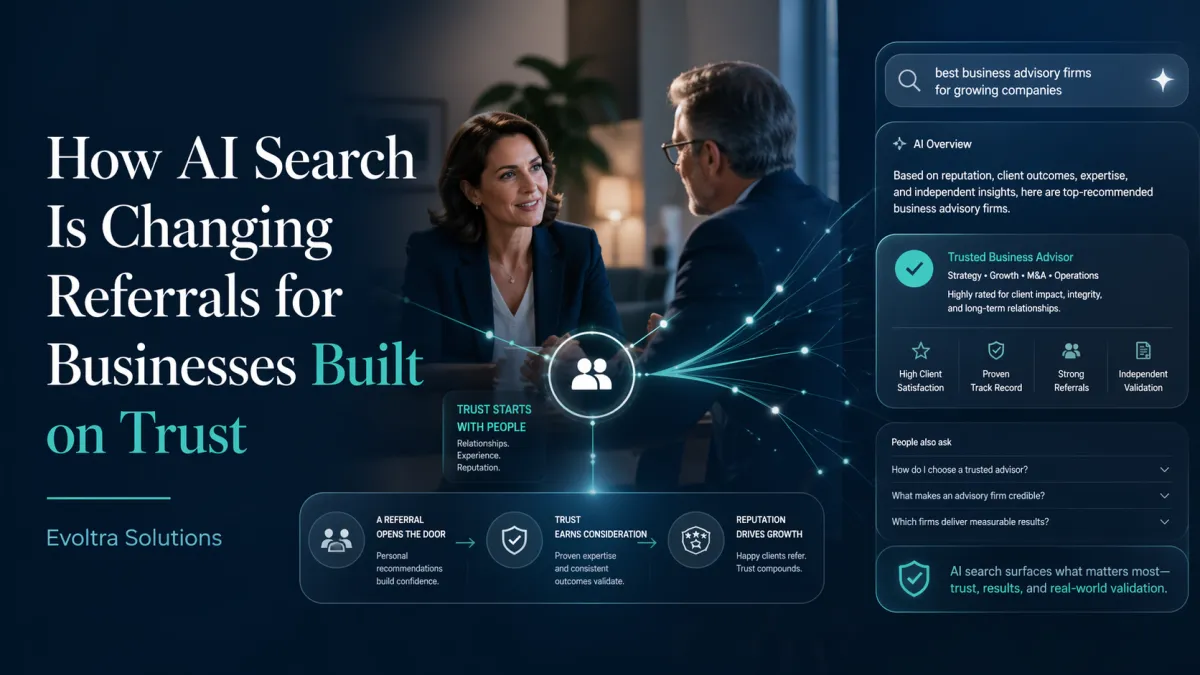
How AI Search Is Changing Referrals for Businesses Built on Trust
Referrals still matter. But the way people validate referrals is changing.
Today, many buyers do not stop at “I know someone you should call.” They take that recommendation and run it through Google, ChatGPT, Perplexity, reviews, LinkedIn, and other online signals before deciding who feels credible enough to contact.
That means AI search is not replacing referrals. It is reshaping them.
For businesses built on trust, that matters a lot. A referral may open the door, but AI search, reviews, and online credibility now help decide whether that door stays open.
The short answer
AI search is changing referrals by adding a new layer of validation between the recommendation and the inquiry.
A potential client may hear your name from a friend, advisor, or colleague. But before reaching out, they often look for confirmation online. They want to know:
what you actually do
who you help
whether your expertise is clear
whether other signals support your reputation
and whether your business appears credible enough to trust
In practical terms, referrals are no longer only about who gets mentioned by people. They are also about who gets reinforced by digital signals.
That shift is especially important for businesses where trust drives the decision.
What are AI search referrals?
AI search referrals happen when a potential customer discovers, evaluates, or gains confidence in a business through an AI-powered search experience.
In the past, a referral journey was often simple:
someone recommended a business
the prospect checked the website
they made contact
Now the path is more layered.
A prospect may:
receive a recommendation
search the business name
ask AI tools follow-up questions
compare providers
read reviews
check credentials
and then decide whether the original referral still feels strong
This means a referral is no longer just passed from person to person. It is often filtered through search, AI summaries, reviews, and online reputation.
Why this matters more for trust-based businesses
Not every buying decision carries the same weight.
If someone is buying a low-cost product, speed and price may drive the choice.
But when someone is choosing a:
lawyer
financial advisor
doctor
therapist
consultant
contractor
agency
or other professional service provider
they are usually making a trust decision, not just a convenience decision.
They are trusting someone with:
money
health
family
property
legal risk
reputation
or business outcomes
That kind of decision usually involves more caution, more questions, and more validation.
AI search has become part of that validation process because people use it to reduce uncertainty. They ask AI tools questions that help them interpret what they are seeing and decide what matters.
Examples include:
What should I look for in a trustworthy estate planning attorney?
How do I choose a financial advisor for a family business?
What makes a marketing agency credible for professional services?
What questions should I ask before hiring a contractor?
Businesses that are easier to understand and easier to verify are better positioned in that environment.
From word-of-mouth to AI-assisted word-of-mouth
Traditional referrals are personal. Someone with direct experience recommends a name.
That still matters. In many industries, it matters a lot.
What has changed is what happens next.
A human referral is now often followed by an AI check.
A prospect may hear your name from a friend and then ask:
Is this company a good fit for my situation?
What do they specialize in?
How do they compare with other providers?
What should I know before contacting them?
That is where AI-assisted word-of-mouth begins.
The referral itself may still come from a person. But the confidence-building process increasingly happens through digital interpretation.
That means your online presence is now part of your referral system.
If your digital footprint reinforces the recommendation, the referral gets stronger.
If your digital footprint is vague, weak, inconsistent, or thin, the referral may lose momentum before the prospect ever contacts you.
The rise of zero-click trust decisions
One of the biggest shifts in AI search is that people can form an opinion before they ever click a website.
In traditional search, the goal was often to win the click.
In AI search, the first impression may happen inside the answer itself.
A prospect may ask a question, read a summary, compare options, and narrow their shortlist before visiting any site in depth. That does not make websites less important. It makes clarity and credibility more important.
For trust-based businesses, this creates a new reality:
Your business may be judged before the first visit, not after it.
That means your website, reviews, business profiles, professional bios, and broader reputation all contribute to whether your business feels credible enough to be considered.
Why some trusted businesses still get overlooked
A business can be excellent in real life and still be weak in AI-assisted discovery.
That happens all the time.
The issue is usually not that the business lacks quality. The issue is that its digital signals do not clearly communicate the quality it already has.
Common gaps include:
vague service descriptions
generic messaging
thin or outdated service pages
weak proof of expertise
inconsistent business information
limited third-party validation
little content that answers buyer questions
In trust-based industries, these gaps matter because the buyer is already cautious. If the online presence adds confusion instead of confidence, the prospect may keep searching.
That does not mean the business is doing bad work. It means the business is easier to overlook than it should be.
What AI search seems to reward in trust-based categories
No business can control exactly how every AI system behaves. But the visible pattern is fairly clear.
Businesses that tend to be reinforced more effectively in AI-assisted research are usually the ones that are:
Clear
Their services, audience, and focus are easy to understand.
Consistent
Their business information, positioning, and online profiles support the same story.
Credible
They show real trust signals such as reviews, credentials, case evidence, professional experience, or visible expertise.
Specific
They describe what they do in real terms, not just polished generalities.
Useful
They publish content that helps prospects understand the problem, the context, or the decision process.
This does not mean every business needs to publish endless content. It does mean the business should be easy to interpret and easy to trust.
Why generic marketing language weakens referrals
Many trust-based businesses unintentionally make themselves harder to trust online by sounding too generic.
Statements like:
we put clients first
we provide customized solutions
we are committed to excellence
we offer trusted professional guidance
may all be true. But they do not say enough.
They do not explain:
who the business serves
what the business actually helps with
what makes the expertise relevant
or why this business is a strong fit for a specific need
That matters because generic copy does not reinforce a referral very well.
A trusted recommendation becomes stronger when the prospect quickly sees:
this is what they do
this is who they help
this is where they have experience
this is why people trust them
When the language is too broad, the business may look polished but still feel hard to evaluate.
Referrals now depend on reinforcement, not just reputation
In the past, a strong reputation alone could carry more of the load.
Today, many prospects still begin with trust, but they often need digital reinforcement before taking action.
That reinforcement may come from:
clear service pages
specific reviews
expert bios
educational articles
third-party mentions
local profile strength
or category clarity across the web
This is one of the biggest changes AI search is bringing to referral-based businesses.
The winning business is not always the one with the most referrals. It is often the one whose digital footprint best supports the referral after it happens.
What this means for businesses built on trust
For businesses that rely on relationships, reputation, and referrals, AI search changes the playing field in an important way:
You now need visibility that reinforces trust, not just marketing that attracts attention.
That means your online presence should help answer questions like:
Is this business clearly positioned?
Does it seem credible?
Is its expertise visible?
Does the digital footprint support the reputation?
Would a cautious buyer feel more confident after researching this company?
Those are not just SEO questions. They are trust questions.
And for many professional firms and service providers, those trust questions are becoming part of the referral journey whether they planned for that or not.
Why this shift creates opportunity
This change is not only a challenge. It is also a real opportunity.
Many trusted businesses still have weak digital reinforcement. Their reputation may be strong offline, but their online presence may not fully reflect that strength yet.
That creates an opening.
The businesses that improve clarity, credibility, and consistency now are more likely to benefit as AI-assisted decision-making grows.
Not because AI replaces trust, but because it increasingly helps shape how trust is confirmed.
FAQ
What are AI search referrals?
AI search referrals happen when a potential customer discovers, validates, or gains confidence in a business through an AI-powered search experience before making contact.
Is AI search replacing referrals?
No. AI search is not replacing referrals. It is changing how people validate them. A human recommendation may still start the process, but digital signals now help determine whether the prospect moves forward.
Why does this matter more for professional service firms?
Because these businesses depend on trust. Buyers usually research more carefully when choosing providers who affect legal, financial, medical, property, or business outcomes.
Can a strong referral still be weakened online?
Yes. If a prospect researches the business and finds unclear services, weak proof, inconsistent information, or little visible expertise, confidence can drop even when the original referral was strong.
What should businesses focus on first?
Usually not on chasing trends. The first priority is making sure the business is clearly positioned, credible, and easy to understand across its most visible online touchpoints.
A practical next step
If your business depends on trust, referrals, and reputation, it is worth asking a simple question:
Does our online presence reinforce the trust people already have in us, or does it leave too much uncertainty?
That question matters more now than it did even a year ago.
Evoltra Solutions helps small businesses and professional service firms evaluate how clearly they are understood across AI search and online trust signals.
A visibility review can help identify where your referral strength is being reinforced, where it is being weakened, and where more clarity may be needed.
Because in this new environment, referrals still matter. But being recommended is only the first step. Being clearly understood and confidently trusted is what helps turn that referral into action.
