Why AI Search Needs More Than a Website to Trust Your Business
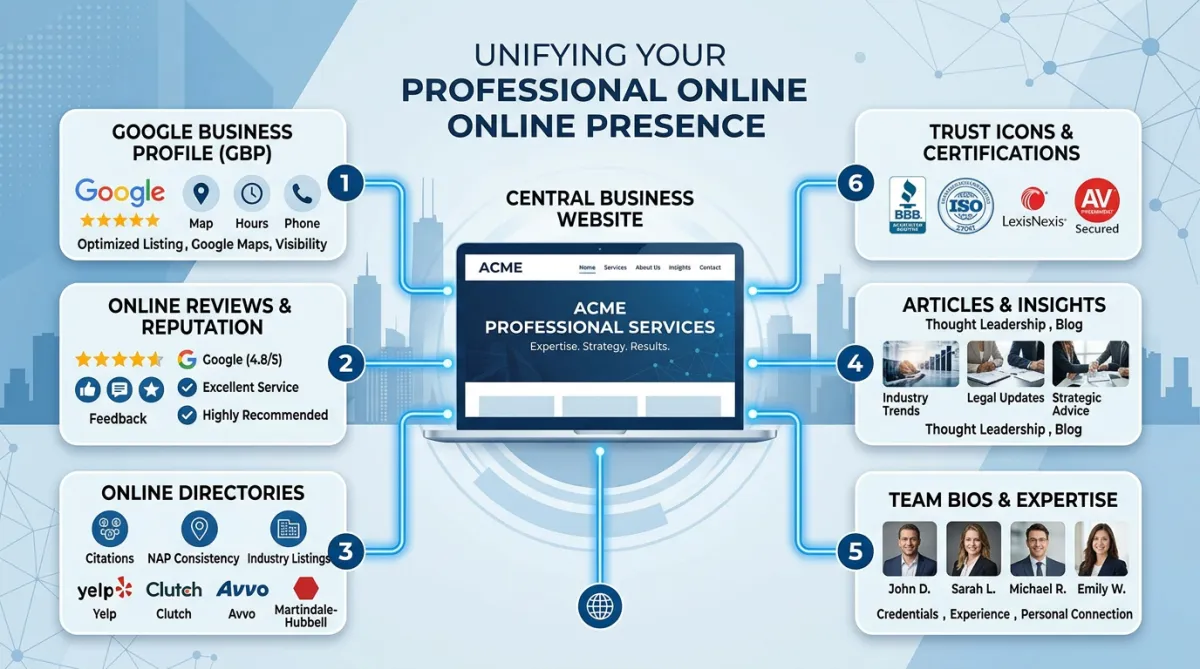
AI search needs more than a website to trust your business because it looks for clarity, consistency, authority, and external confirmation across multiple sources. Your website is important, but Google and AI search tools also evaluate signals from your Google Business Profile, online profiles, reviews, citations, content, structured data, and third-party references.
For professional service firms, this matters because trust often comes before the first phone call. A person looking for a probate attorney, estate planning attorney, elder law attorney, financial professional, mortgage professional, or advisor is not only asking, “Who offers this service?” They are also asking, “Who can I understand, verify, and trust?”
AI search is still evolving. No business can guarantee that Google, ChatGPT, Perplexity, or another AI tool will recommend it for every question. But businesses can strengthen the signals that help search engines and AI systems better understand who they are, what they do, who they serve, and why they are credible.
Why Having a Website Is Only the Starting Point
A website is the foundation of online visibility, but it is not the entire trust picture.
Your website tells Google and AI search what you say about your business. Other sources help confirm whether that message is consistent and credible. Google’s SEO guidance explains that SEO helps search engines crawl, index, and understand content, which means the website still matters as a discoverable source of information.
The problem is that many business websites are too vague to build confidence. They may look polished, but they do not clearly explain services, client types, locations, credentials, or areas of expertise.
A law firm website might say, “We provide compassionate legal guidance for families.” That sounds warm, but it does not tell AI search whether the firm handles probate, estate planning, guardianship, elder law, Medicaid planning, trust administration, or real estate matters.
A financial professional may say, “We help clients plan for the future.” That does not clarify whether the firm serves retirees, business owners, families with special needs planning concerns, or high-income professionals.
A website is useful when it creates clarity. It is weaker when it leaves search engines, AI systems, and prospects guessing.
What AI Search and Google Need to Understand
AI search trust signals help answer basic questions about your business.
Google and AI systems need to understand:
Who the business is
What services it provides
Where it operates
Who it serves
What topics it has expertise in
Whether the information is consistent across the web
Whether other sources support or confirm that authority
This is especially important as search shifts from simple keyword matching toward answer generation. OpenAI says ChatGPT search can provide timely answers with links to relevant web sources, and Google says AI features such as AI Overviews and AI Mode connect users with web content through AI-powered search experiences.
For business owners, the practical takeaway is simple. AI search does not only need pages. It needs confidence.
If your website says one thing, your Google Business Profile says another, your directory listings use outdated categories, and your reviews mention services you no longer prioritize, your online presence may create confusion.
Clear, repeated, verifiable signals make your business easier to understand.
What “Trust” Means in AI Search
Trust in AI search is not only about reviews. Reviews matter, but they are only one part of the picture.
In AI search, trust means the business appears clear, consistent, relevant, authoritative, and supported by multiple sources. It is the difference between a business that is easy to verify and one that raises unanswered questions.
For professional service firms, trust includes five major elements.
Clarity: The business clearly explains what it does.
Consistency: The same core facts appear across the website, Google Business Profile, directories, social profiles, and citations.
Authority: The business shows expertise through service pages, educational content, bios, credentials, and topical depth.
Relevance: The business connects its services to the real problems clients ask about.
Confirmation: Third-party sources, reviews, mentions, and profiles support the business’s claims.
Google’s helpful content guidance emphasizes reliable, people-first content, and its public guidance on experience, expertise, authoritativeness, and trust explains why trust is a central part of quality evaluation.
For law firms, estate planning attorneys, financial professionals, and other trust-based businesses, these signals are not just marketing details. They help prospects decide whether to keep reading, keep comparing, or reach out.
The Trust Signals That Matter Most
AI search trust signals work best when they support the same clear message across your online presence.
Clear Service Pages
Service pages should explain what the business does in specific terms.
A probate attorney should have a page that explains probate administration, not only “estate services.” A mortgage professional should distinguish purchase loans, refinancing, first-time buyer support, investment property financing, and jumbo loans if those are core services.
Strong service pages help Google, AI search, and prospects connect the business to specific needs.
Helpful Educational Content
Educational content helps show expertise before a prospect contacts you.
A law firm might publish articles answering common questions about probate timelines, trust administration, guardianship, or estate disputes. A financial professional might explain retirement income planning, beneficiary updates, or planning after a spouse dies.
This content should not be generic. It should answer real client questions in a clear, practical way.
FAQs That Answer Real Client Questions
FAQ content is valuable because it mirrors how people ask questions.
For example:
“What happens if a parent dies without a will in Florida?”
“Can I refinance if I recently changed jobs?”
“Do I need an estate plan if my spouse already owns everything?”
These questions help AI search understand the firm’s topics and the client concerns it addresses.
Google Business Profile Consistency
Your Google Business Profile is a key local visibility asset.
The business name, categories, services, location, phone number, website link, business hours, and description should align with your website and other profiles. Inconsistent categories or outdated services can weaken business credibility.
This is especially important for Google visibility for law firms and local authority SEO.
Reviews and Reputation Signals
Reviews help show how real clients describe the business.
The content of reviews can matter as much as the number. If an estate planning firm wants to grow trust planning services, but all reviews only mention real estate closings from five years ago, the review profile may not support the current positioning.
Professional service firms should never manipulate reviews, but they should pay attention to whether their reputation signals reflect the services they want to be known for.
Local Citations and Directory Profiles
Citations are references to your business information on other websites. They often include name, address, phone number, website, category, and description.
For law firms, citations may include legal directories, bar-related profiles, local business directories, chamber listings, and professional association pages. For mortgage and financial professionals, relevant licensing, directory, and industry profiles may also matter.
Consistent citations help reinforce identity and local authority.
Author or Team Bios
Professional service firms should make expertise visible.
Thin bios that only list a name and title do not build much trust. Strong bios explain credentials, experience, focus areas, professional memberships, publications, speaking experience, and client types served.
For legal, financial, and advisory services, people want to know who is behind the guidance.
Schema and Structured Data
Schema, also called structured data, helps search engines understand page information more clearly. It can identify content types such as local business details, articles, FAQs, reviews, services, people, and organizations when used appropriately.
This does not guarantee rankings or AI mentions. It simply makes information easier for search engines to interpret.
Third-Party Mentions and References
Third-party references can include local media mentions, podcasts, guest articles, professional association pages, speaking event pages, community involvement, awards, and partner pages.
These references help confirm that the business exists beyond its own website.
Why This Matters for Law Firms and Professional Service Firms
People do not casually choose a probate attorney, estate planning attorney, elder law attorney, financial professional, or mortgage advisor.
They often reach out during major life moments. A parent has passed away. A family needs long-term care planning. A homeowner is buying a property. A couple is preparing an estate plan. A business owner is protecting assets. A retiree is making income decisions.
In these situations, credibility matters before contact.
If a firm’s online presence is unclear, inconsistent, or thin, prospects may move on to a competitor who feels easier to understand and trust. AI search may do something similar. It may favor businesses with stronger clarity, better content, more complete profiles, and clearer third-party confirmation.
This is not about being the biggest firm. A smaller professional service firm can still build strong AI search visibility if its trust signals are organized and consistent.
Common Visibility Gaps That Weaken Trust
Many firms have visibility gaps they do not notice because the business still has a website and some online profiles.
Common gaps include:
The website says one thing, but the Google Business Profile says another.
Service pages are too general to explain what the firm actually handles.
FAQ content does not answer real client concerns.
There is no schema or structured data where it would be appropriate.
Business categories are inconsistent across listings.
Attorney, advisor, or team bios show little expertise.
Blog content does not connect to core services.
The website lacks local relevance.
External references and citations are limited.
Reviews do not reflect the services the firm wants to grow.
Internal links do not connect related services and articles.
Old services remain visible while current priorities are hidden.
These issues do not always break visibility completely. They create friction.
When AI search has to choose between a business with clear, supported signals and one with scattered signals, the clearer business is easier to trust.
How Businesses Can Begin Improving AI Search Trust Signals
Improving AI search visibility does not require chasing every new tool or trend. It starts with making your business easier to understand.
A practical starting point is to review how your business appears in Google and AI search. Look at what comes up for your business name, primary services, local service area, and common client questions.
Next, review your website for clarity. Ask whether a first-time visitor can quickly understand who you help, what you do, where you work, and why you are credible.
Strengthen your core service pages before creating large amounts of new content. Each page should explain the service, who it is for, common concerns, related questions, and why your firm is qualified to help.
Add useful FAQs where they naturally fit. FAQs can improve the reader experience and help answer engines understand how your business relates to client questions.
Update your Google Business Profile so your categories, services, description, and contact details match your website.
Build consistency across important citations and directories. For local authority SEO, the same name, address, phone number, website, and service categories should appear across trusted platforms.
Organize content around core expertise. A law firm that wants visibility for estate planning should connect estate planning service pages, attorney bios, FAQs, blog posts, and related resources. A mortgage professional should connect purchase, refinance, local market, and buyer education content.
Add schema where appropriate, preferably with qualified technical support.
The goal is not to create a one-time checklist. The goal is to build a clearer visibility foundation.
Why This Should Be Part of a Long-Term Visibility Strategy
AI visibility and Google visibility are not one-time projects.
Business information changes. Services evolve. Attorneys join or leave. Reviews accumulate. Google Business Profile features change. AI search experiences continue to develop. Competitors update their content and profiles.
A long-term visibility strategy keeps your trust signals current.
For professional service firms, this means regularly updating service pages, publishing useful educational content, keeping profiles accurate, reviewing citations, improving internal links, strengthening bios, and documenting authority through credible references.
Google has stated that AI experiences in Search are part of an evolution in how people search, with users asking more complex questions and exploring web content in new ways.
That evolution makes clarity more valuable, not less.
The businesses that benefit most are often the ones that treat visibility as an ongoing reputation asset. They do not only ask, “Are we ranking?” They ask, “Are we understandable, credible, and consistent everywhere a prospect or AI system might evaluate us?”
Where Evoltra Fits Into the Conversation
Evoltra Solutions approaches AI search optimization as a visibility and trust strategy, not as a quick marketing trick.
For trust-based professional service firms, the first need is often diagnosis. Before creating more content, changing a website, or chasing another marketing tactic, a business needs to understand how clearly it is being represented online.
That means looking at whether Google and AI search can easily understand:
who the business is,
what services it provides,
where it operates,
who it serves,
what topics it should be known for, and
whether its online trust signals are consistent across the web.
An AI search visibility review can look at how your business appears across your website, Google Business Profile, online profiles, service pages, reviews, content, citations, structured data, and third-party references.
The purpose is not to promise guaranteed AI recommendations. The purpose is to identify where trust signals may be missing and where your online presence can become clearer, stronger, and more consistent.
For professional service firms, that clarity matters. When your expertise is easier to understand, it becomes easier for prospects, search engines, and AI-powered search experiences to connect your business with the right questions.
FAQ
Does my business still need a website for AI search?
Yes. Your website remains the central source for explaining your services, expertise, location, team, and client focus. AI search may also look at other sources, but your website is still the foundation of your online visibility.
Can AI search understand my business if my website is outdated?
It may understand parts of your business, but an outdated website can create confusion. If old services, old bios, outdated locations, or vague descriptions remain online, Google and AI search may have a less accurate picture of your business.
What are trust signals in online visibility?
Trust signals are the pieces of information that help search engines, AI systems, and prospects believe your business is legitimate, relevant, and credible. They include clear service pages, reviews, consistent profiles, bios, citations, educational content, structured data, and third-party references.
Is SEO still important with AI search?
Yes. SEO is still important because search engines need to crawl, index, and understand your content. AI search adds another layer by increasing the importance of clear answers, structured information, authority, and consistency.
What is AEO?
AEO stands for Answer Engine Optimization. It is the practice of structuring content so AI tools, search engines, and answer engines can understand, summarize, and cite information more confidently.
How can a professional service firm improve AI visibility?
A professional service firm can improve AI visibility by clarifying its service pages, strengthening bios, updating its Google Business Profile, answering client questions, building consistent citations, improving reviews, organizing content by expertise, and adding structured data where appropriate.
Can businesses guarantee that AI tools will recommend them?
No. No business can guarantee that ChatGPT, Google AI Overviews, Perplexity, or another AI tool will recommend a specific company. Businesses can strengthen the trust signals that make them easier to understand, verify, and consider.
Final Takeaway
AI search needs more than a website because trust is built from multiple signals.
Your website matters, but it works best when it is supported by clear service pages, helpful content, consistent profiles, reviews, citations, structured data, team expertise, and third-party confirmation.
For professional service firms, this is especially important. Prospects are not only looking for a provider. They are looking for a credible guide they can trust with a serious decision.
If you are not sure whether your online presence is clear enough for Google and AI search to understand, Evoltra can help you review your visibility foundation and identify where clarity, consistency, and trust signals may be missing.
