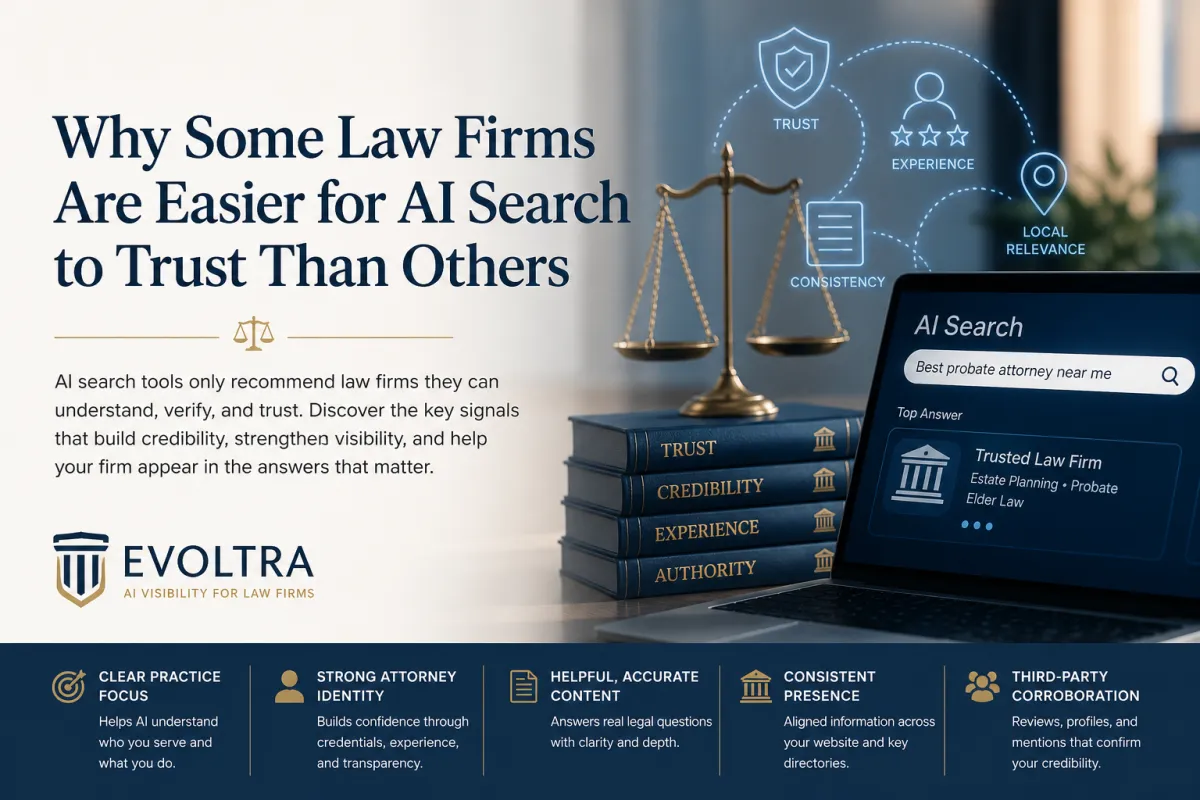
Why Some Law Firms Are Easier for AI Search to Trust Than Others
Some law firms are easier for AI search to trust because their online presence is clearer, more consistent, more credible, and easier to verify across multiple sources. AI tools need confidence before mentioning a law firm in an answer, especially because legal topics can affect a person’s rights, finances, family, immigration status, safety, or future.
This does not mean the best law firm always appears first. It means the law firm that is easiest to understand and verify often has an advantage.
For law firms, AI visibility is no longer only about ranking in Google. It is also about whether tools like ChatGPT, Google AI Overviews, Perplexity, and other answer engines can identify the firm, understand its practice areas, verify its credibility, and confidently connect it to a user’s legal question.
AI Search Trust Means Confidence, Not Personal Preference
AI search trust is the level of confidence an AI system has that a law firm is relevant, credible, and safe to mention in response to a legal question.
Traditional search results often show a list of pages. AI search often creates a summarized answer. That answer may include explanations, citations, recommended next steps, or a short list of businesses.
For law firms, this creates a higher standard. AI systems must decide which sources are clear enough and trustworthy enough to use.
A law firm with a polished website can still be difficult for AI tools to trust if the site is vague, thin, outdated, or unsupported by outside sources. A smaller firm can be easier to trust if its information is specific, consistent, well-structured, and backed by credible signals.
Why Legal Content Requires a Higher Trust Standard
Legal content sits in a sensitive category because it can influence important decisions. A person searching for help after a divorce, probate matter, immigration issue, accident, business dispute, criminal charge, or estate planning concern is not looking for casual information. They are making decisions that can affect money, family, legal rights, timing, and long-term outcomes.
That is why AI tools tend to apply a higher standard to legal topics. They need stronger confidence before surfacing or referencing a law firm in response to a legal question.
A weak legal page is not just unhelpful. It can create confusion at exactly the moment a person needs clarity.
That is why AI tools are more likely to favor law firms that make their qualifications, practice focus, location, attorneys, and supporting evidence easier to evaluate.
The Main Reason Some Law Firms Are Easier to Trust
The main reason some law firms are easier for AI search to trust is that they reduce uncertainty.
AI tools need to answer basic questions about the firm:
What does this law firm do?
Where does it practice?
Which clients does it help?
Which legal matters does it handle?
Who are the attorneys?
Is the firm licensed, credible, and active?
Do outside sources confirm the firm’s reputation?
Does the website provide helpful, accurate information?
Is the firm’s information consistent across the web?
When the answers are obvious, the firm becomes easier to classify and surface.
When the answers are vague or inconsistent, AI systems may skip the firm and rely on clearer sources instead.
Signal 1: Clear Practice Area Positioning
Clear positioning is one of the strongest trust signals for AI search.
A vague law firm website says:
“We provide experienced legal solutions for individuals and businesses.”
A clearer version says:
“Our firm helps families with probate, estate administration, wills, trusts, and elder law planning in Florida.”
Or:
“Our firm represents clients in family-based immigration matters, adjustment of status, naturalization, and deportation defense.”
Or:
“Our firm handles divorce, custody, support, and marital property matters for clients navigating major family transitions.”
The clearer description is easier for AI tools to understand. It identifies the practice area, client type, and specific legal issues involved.
Many law firms weaken their visibility by trying to sound broad. They describe themselves as experienced, client-focused, or results-driven without clearly stating what they actually handle.
AI search needs specific legal categories. A firm that handles family law should clarify whether it focuses on divorce, custody, child support, prenuptial agreements, mediation, or domestic violence matters. A firm that handles estate planning should specify wills, trusts, incapacity planning, probate, guardianship, or elder law. A firm that handles immigration should clarify visas, family petitions, asylum, removal defense, or citizenship matters.
Clear practice positioning helps AI tools match the firm to specific user questions.
Signal 2: Strong Attorney and Firm Identity
AI systems need to understand who is behind the legal information.
Law firm websites are stronger when they clearly show attorney names, biographies, credentials, bar admissions, jurisdictions, education, speaking experience, publications, and relevant background.
A legal article with no named author is weaker than one written or reviewed by a clearly identified attorney. A practice page with no visible connection to the lawyers handling that matter is weaker than one tied to the attorneys who actually do the work.
This matters for both AI search and human trust.
A person researching a legal problem wants to know who may be guiding them. AI tools also need reliable entity information. The attorney, law firm, practice area, location, and legal topic should connect cleanly across the website and third-party profiles.
For example, a probate page should naturally connect to the attorneys who handle probate matters, the firm’s service area, its educational content, and its supporting public profiles. The same applies to immigration, family law, business law, bankruptcy, or personal injury.
Signal 3: Helpful Legal Content, Not Generic SEO Copy
AI search is less likely to trust content that feels generic, shallow, or written only to fill space.
For law firms, thin blog posts are not enough.
A weak legal article says:
“If you are going through probate, contact an attorney right away.”
A stronger article explains:
what probate is
when it may be required
what common delays or misunderstandings exist
what family members often get wrong
what documents may matter
why timelines vary
when professional legal guidance becomes important
The same pattern applies across practice areas. A stronger immigration article explains what issue the reader may be facing, what general process is involved, where confusion usually happens, and why accurate legal guidance matters. A stronger divorce article explains how certain issues affect finances, property, parenting, or timing. A stronger business law article explains the real decision points behind the search, not just broad legal language.
AI tools are more likely to trust content that answers the real question behind the search.
People rarely ask legal questions in perfect marketing terms. They ask questions like:
“Do I need probate if there is a will?”
“Can I lose my green card if I divorce?”
“How is a house handled in a divorce?”
“What happens if a parent dies without a trust?”
“Can I sponsor my spouse if I have temporary status?”
“What should I do if I am served with a business lawsuit?”
Law firms become easier to trust when their content explains these issues clearly, responsibly, and in a way that reflects real client concerns.
Signal 4: Consistent Local and Practice Area Signals
Law firm AI visibility often depends on consistency.
A firm may describe itself one way on its website, another way on Google Business Profile, another way on Avvo, another way on Justia, and another way on LinkedIn. That creates friction.
AI tools are better able to understand a firm when key details align across sources:
Firm name
Address
Phone number
Website URL
Attorney names
Practice areas
Jurisdictions
Office locations
Business hours
Professional profiles
Review profiles
This is especially important for local legal searches. A user may ask for a probate lawyer in Tampa, a divorce attorney near Miami, an immigration lawyer in Orlando, or an elder law attorney in Broward.
If a firm’s location and practice area signals are inconsistent, AI tools may have less confidence that the firm is relevant.
Consistency does not mean every profile must use identical wording. It means the same core facts should appear clearly across the web.
Signal 5: Third-Party Corroboration
AI search trust does not come only from the law firm’s own website.
Third-party corroboration helps confirm that the firm is real, active, and recognized. For law firms, this can include:
State bar profiles
Legal directory profiles
Google Business Profile
Review platforms
Local business listings
Legal publications
News mentions
Podcast interviews
Speaking engagements
Association memberships
Community involvement
Client reviews
Peer recognition
A firm that only describes itself on its own website may be harder to verify. A firm with consistent third-party references is easier for AI tools to connect to a legal category, location, and reputation.
This is not about chasing every directory. It is about making sure the most credible sources confirm the same basic story.
For lawyers, official and reputable profiles matter. State bar information, professional associations, respected legal directories, and well-maintained local listings can all support trust.
Signal 6: Evidence of Real Experience
AI search tools are more likely to trust law firms that show experience in concrete ways.
Experience signals can include:
Attorney bios with specific background
Representative matters
Case results where ethically permitted
Client testimonials where allowed
Practice-specific FAQs
Industry-specific examples
Publications by attorneys
Speaking engagements
Clear explanations of legal processes
The key is specificity.
A phrase like “decades of combined experience” is less useful than a clear explanation of the matters the firm handles. “We help families navigate probate administration, ancillary probate, and trust-related estate issues in Florida” is easier to understand than “we offer comprehensive probate services.”
Law firms should also be careful with claims. Ethics rules vary by jurisdiction, and legal marketing cannot overpromise outcomes. Trust grows when content is clear, accurate, and responsibly framed.
Signal 7: Content That Separates Legal Information From Legal Advice
AI tools and human readers both benefit when a law firm clearly separates general legal education from legal advice.
A trustworthy law firm article explains the legal issue in general terms, identifies when a reader should speak to a lawyer, and avoids creating unrealistic expectations. It does not imply that every reader has the same facts or the same outcome.
This is especially important in AI search because users often ask broad legal questions with missing details.
A responsible article might say:
“Whether probate is required depends on how assets were titled, whether a trust exists, the size of the estate, and the laws of the state involved. An attorney can review the specific facts before advising on next steps.”
That is more trustworthy than a sentence that sounds absolute.
AI systems need content that is useful without being misleading.
Why a Website Alone Is Not Enough
A law firm website is necessary, but it is not the whole trust picture.
AI tools may consider information from search results, business profiles, citations, reviews, directories, and other public sources. A website tells AI systems what the firm says about itself. Third-party sources help confirm whether that information is accurate and consistently supported.
A modern website can still underperform if:
Attorney bios are thin
Practice pages are generic
Content lacks jurisdiction-specific detail
Local profiles are incomplete
Reviews are weak or inconsistent
Directory profiles conflict
The firm has little topical depth
The site gives no clear proof of experience
The firm’s name, address, or phone number varies across platforms
AI trust is built from multiple signals working together.
Why Some Law Firms Misdiagnose the Problem
Many law firms assume low AI visibility means they simply need more content. Sometimes they do. But more content alone will not fix a trust problem.
Common misdiagnoses include:
“We Need More Blog Posts”
Publishing more articles does not help if the articles are generic, duplicative, or disconnected from the firm’s real practice areas.
A firm does not need hundreds of shallow posts. It needs clear, authoritative content that answers the questions its ideal clients actually ask.
“Our Website Looks Professional, So We Should Be Mentioned”
Design matters to users, but AI systems depend heavily on text, structure, clarity, and corroboration.
A visually polished site can still be hard to understand if it uses vague language or hides important information.
“We Rank in Google, So AI Should Trust Us”
Traditional rankings help, but AI visibility is not identical to standard SEO. A law firm can rank for some terms and still fail to appear in AI-generated recommendations if its trust signals are weak or unclear.
“Our Competitor Is Showing Up Because They Spend More”
Budget can help, but clarity often matters more than size. A smaller firm with focused practice pages, strong attorney bios, consistent profiles, and credible third-party proof can be easier for AI tools to understand than a larger firm with scattered messaging.
What Law Firms Should Prioritize First
Law firms should prioritize trust foundations before chasing advanced AI tactics.
The strongest starting points are:
Clear practice area positioning
Detailed attorney biographies
Strong primary practice pages
Consistent local and directory profiles
Credible reviews and testimonials
Helpful legal content with jurisdiction-specific context
Clear disclaimers and responsible explanations
Technical SEO that allows pages to be crawled and understood
The goal is not to manipulate AI systems. The goal is to make the firm easier to understand, verify, and surface with confidence.
For many firms, the issue is not effort. It is lack of clarity, consistency, and structure across the digital footprint.
How SEO and AEO Work Together for Law Firms
SEO and Answer Engine Optimization, or AEO, should work together.
SEO helps search engines discover and understand a law firm’s pages. AEO helps AI systems extract clear answers, identify entities, and connect the firm to specific legal questions.
For law firms, this means content should be:
Searchable
Accurate
Well-structured
Locally relevant
Written or reviewed by qualified attorneys
Supported by clear practice area pages
Connected to attorney bios
Consistent with third-party profiles
Helpful to real potential clients
AEO does not replace SEO. It raises the standard for clarity and trust.
FAQ: AI Search Trust for Law Firms
Why do some law firms appear in AI search answers while others do not?
Some law firms appear because their practice areas, attorneys, locations, reviews, and third-party profiles are easier for AI tools to understand and verify. AI tools tend to avoid unclear or poorly supported recommendations.
Is AI search visibility the same as SEO for law firms?
No. SEO focuses on visibility in traditional search results. AI search visibility focuses on whether AI tools can understand, summarize, cite, or recommend a law firm in generated answers. The two overlap, but they are not identical.
Can a small law firm compete in AI search?
Yes. A small law firm can compete when its practice focus is clear, attorney credentials are visible, content is useful, reviews are credible, and third-party profiles consistently support the same facts.
Does AI search use reviews?
Reviews are not the only trust signal, but they can support credibility when they are consistent, relevant, and genuine.
Should law firms use AI to write all their content?
Law firms should be cautious. AI-assisted content can be useful, but legal content should still be reviewed carefully for accuracy, jurisdiction, ethics compliance, and client safety.
What is the first thing a law firm should review?
A law firm should first review whether its website and public profiles clearly answer four questions: what the firm does, where it practices, who the attorneys are, and why the firm should be trusted.
Bottom Line
Some law firms are easier for AI search to trust because they reduce uncertainty. Their websites explain their practice areas clearly. Their attorneys are visible. Their content is helpful and accurate. Their profiles are consistent. Their reputation is supported by credible third-party sources.
AI search does not simply reward the loudest firm or the largest website. It favors information that can be found, understood, verified, and responsibly used in an answer.
For law firms, the path forward is not hype. It is clarity, credibility, consistency, and responsible legal education.
If a law firm wants stronger visibility in AI search, a useful first question is simple: can an AI tool quickly understand who we are, what we do, where we practice, and why we should be trusted?
If the answer is not obvious, that is usually where the real visibility problem begins.
A professional visibility review can help identify where that trust breaks down across the website, profiles, content, and broader digital footprint, before the firm wastes more time publishing content that never becomes easy for AI search to trust.
